Worldbuilding

A living lore bible for your game world

Create a living game lore bible for history, factions, religions, magic systems, locations and characters. Searchable entries and contextual AI help indie teams preserve continuity without maintaining one enormous design document.

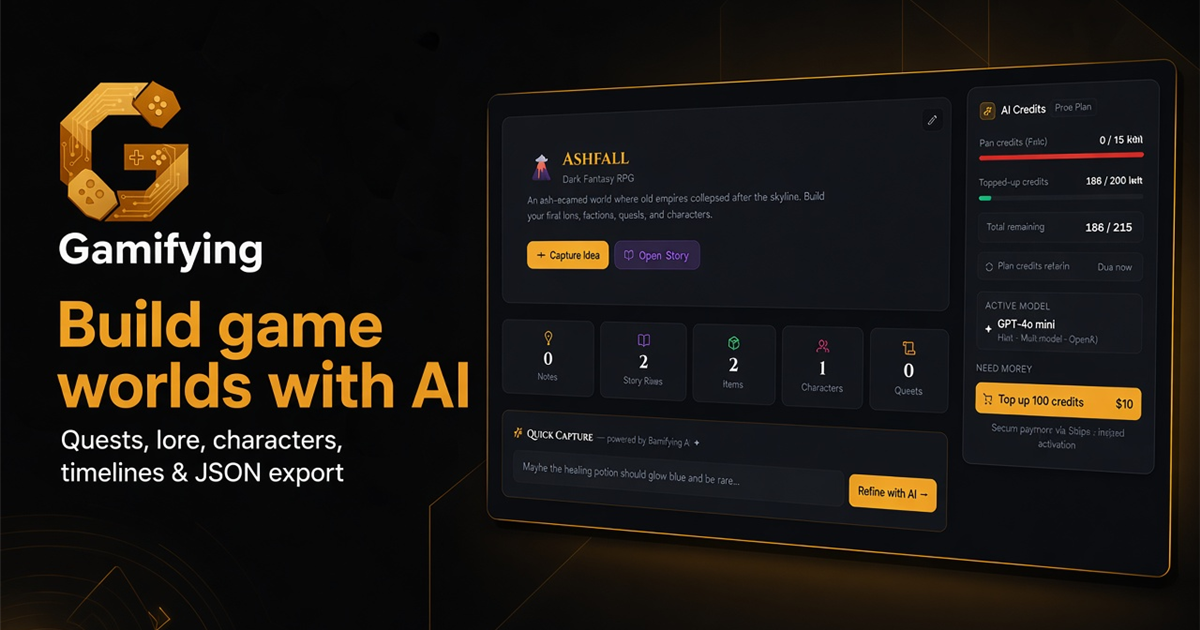
Gamifying AI game design dashboard showing a structured game workspace
Gamifying workspace for AI-assisted game design and worldbuilding.

Built for an actual game-production workflow

Organise world history, factions, beliefs and rules by entry type

Keep locations, characters and quests close to their source lore

Use contextual AI to expand ideas while retaining ownership

Map world events on a visual narrative timeline

A searchable source of truth for your game world

Replace scattered notes with categorized lore entries that are easy to browse and revise. A structured world bible helps new collaborators understand established facts and gives the whole team one place to check names, relationships and rules.

Worldbuilding that stays connected to production

Lore becomes useful when it informs playable content. Link your thinking across characters, locations, quests, dialogue and timeline events, then move implementation tasks onto the workboard without losing narrative context.

AI assistance grounded in your own material

Refine a faction, deepen a historical conflict or draft a character background using the workspace around it as context. Generated material is treated as a starting point: review it, edit it and make it part of your canon only when it fits.

Frequently asked questions

What belongs in a game lore bible?

A useful lore bible covers history, factions, religions, magic systems, locations, characters and the rules that keep a fictional world consistent.

Can AI help expand existing worldbuilding?

Yes. Gamifying uses your current workspace context to refine or expand ideas while keeping the result editable and connected to the rest of the world.

Is Gamifying suitable for RPG worldbuilding?

Yes. Its structured characters, quests, locations, lore, timelines and dialogue tools are designed for interconnected worlds such as RPGs and narrative games.